Archive for September, 2005

What is Fiduciary joint control?

Friday, September 30th, 2005

Let’s say joint control means that the cash of the estate is deposited in a bank account in a manner that will prevent withdrawals unless the surety consents. Securities and other similar valuables are placed in a safety deposit box. Access to the box is conditioned on the presence of some authorized representative of the surety house. At the time the bond application is signed, the principal also signs joint control agreements in duplicate, one copy the bank retains the other acknowledged by the bank and returned to the surety copies to principal and attorney.

What are title bonds?

Friday, September 30th, 2005

[While reading quick summaries of different kinds of bonds, I paused on the description of title bonds. I think they illustrate well the basic idea behind bonds, and how they act as a mechanism of trust between two parties.]

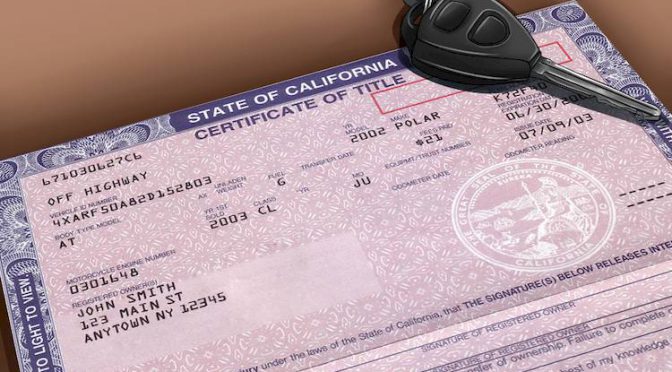
Title bonds are required usually by state governments before they will reissue titles for larger items like cars. They bond you to your claim that you have legitimate ownership of the item in question, so that people can’t just go around stealing things and filling out some paperwork to have it legally defined as theirs.

For instance, let’s say you lost your copy of the title to your truck that you bought from that shady little used car lot way out of town. Maybe you never got a proper title from the dealership; they didn’t have one at the time, they said, and a bill of sale would be just as good. After a few years, you decide to sell it, but the buyer says that a bill of sale is not enough, that you will need to get a title to transfer to him. You try to find the dealership to get a copy, but find out that they went out of business, got shut down for “correcting” their lot’s odometers, and that no trace of them remains.

Now, in order to get a title reissued by the state, you will need to buy a title bond from a bonding agency like Bernard Fleischer & Sons. The state will generally decide how much we will have to write the bond for. That bond will guarantee any damage done to the car while it is in your possession, in the event that a more legitimate title-holder materialized later on. Perhaps you discover that your dealership was “correcting” ownership on their cars as well as mileage. Now you just have to hope that the shady dealership way out of town had posted a Motor Vehicle Dealer Bond.


What is a Fiduciary?

Thursday, September 29th, 2005

A Fiduciary is a person appointed to handle the affairs of another who, for one reason or another is unable to handle their own affairs. If the reason is the person is a minor, the fiduciary is called a guardian. When the reason is death, the court appoints an administrator. If the deceased has left a will, naming some person to be the administrator, the court usually permits that person to quilify that person is an executor.

If the reason is mental incompetence, physical disability, inability to conserve his own assets, the fiduciary is called a committee, a conservator or a guardian.

When a businessman’s financial affairs become involved, an assignee for the benefit of the creditors is named. If placed in a receivership a fiduciary is known as a receiver.

Please note: Fiduciaries are usually required by statute to furnish bonds, conditioned on their faithfully performing their duties in their appointed capacities.

What are Court Bonds?

Wednesday, September 14th, 2005

[Bill Walsh, our V.P. and senior bond-theorist, started me out on Court Bonds. He handed me a little book and said, “These are the most confusing kinds of bonds.” Here’s what I’ve made out of the confusion:]

Court Bonds relate to court proceedings, all of which involve two parties: the plaintiff and the defendant. So it makes sense that court bonds are divided into two categories: Plaintiff’s Bonds and Defendant’s Bonds. Both of these bonds are required as protection for the other party. Plaintiff’s bonds protect the defendant–bond the plaintiff to the defendant’s protection, if you will–and defendant’s bonds protect the plaintiff.

An example of a Plaintiff’s Bond–one specifically called an attachment bond–would be if the plaintiff was claiming that the defendant owed him, say, several thousand dollars. The plaintiff could “attach” something like the defendant’s car so that, if the court ruled in the plaintiff’s favor, the defendant’s car could be sold to pay the plaintiff his money. The problem with this is that the court may not rule with the plaintiff, which would be depriving the defendant of his car for no good reason. The plaintiff’s bond assures that the defendant will be compensated for his loss, perhaps at the plaintiff’s expense.

An example of a Defendant’s Bond–one specifically called a garnishment bond–would be if the plaintiff, let’s say a car dealership, sold the defendant a car, to be paid for in monthly installments. If the defendant then didn’t pay his bills from the dealership, they could ask the courts for the power to “garnish” the money straight out of the defendant’s salary. However, it’s possible that the court might not allow the dealership to garnish the defendant’s salary, and maybe instead would tell them to just take back the car. The the dealership therefore has to buy a garnishment bond promising that they will cover whatever losses the defendant sustained from his salary being garnished, if it turns out that they’re just going to repossess the car.

Introduction: The Blog Guy

Monday, September 12th, 2005

Hi and welcome to The Bonded Blog of Bernard Fleischer and Associates. I’m The Blog Guy, and I’m the newest addition to the company. My job is basically to get this weblog up and running, and on its way to being a truly useful resource for people who need to learn about the myriad different bonds and insurance services we have to offer. I will be researching the topic along the way, writing what I learn in as clear and non-technical a language as possible.

When you’re buying a home, consider the cost of homeowners insurance.

Monday, September 5th, 2005

You may pay less for insurance if you buy a house close to a fire hydrant or in a community that has a professional rather than a volunteer fire department. It may also be cheaper if your home’s electrical, heating and plumbing systems are less than 10 years old. If you live in the East, consider a brick home because it’s more wind resistant. If you live in an earthquake-prone area, look for a wooden frame house because it is more likely to withstand this type of disaster. Choosing wisely could cut your premiums by 5 to 15 percent.

Check the CLUE (Comprehensive Loss Underwriting Exchange) report of the home you are thinking of buying. These reports contain the insurance claim history of the property and can help you judge some of the problems the house may have.

Remember that flood insurance and earthquake damage are not covered by a standard homeowners policy. If you buy a house in a flood-prone area, you’ll have to pay for a flood insurance policy that costs an average of $400 a year. The Federal Emergency Management Agency provides useful information on flood insurance on its Web site at www.fema.gov/nfip. A separate earthquake policy is available from most insurance companies. The cost of the coverage will depend on the likelihood of earthquakes in your area.
In California the California Earthquake Authority (www.earthquakeauthority.com) provides this coverage.

If you have questions about insurance for any of your possessions, be sure to ask your agent or company representative when you’re shopping around for a policy. For example, if you run a business out of your home, be sure to discuss coverage for that business. Most homeowners policies cover business equipment in the home, but only up to $2,500 and they offer no business liability insurance. Although you want to lower your homeowners insurance cost, you also want to make certain you have all the coverage you need.>